Skip to content

Choosing a flat roof material sounds simple until you start comparing them. Felt, fibreglass and rubber all do the same job on paper, but they age very differently in wet Irish weather. That is where EPDM roofing in Ireland stands out for most homeowners.
It is popular because it is durable, low maintenance, and good value, with a lifespan of 20 to 30 years and a typical installed cost of €90 to €140 per square metre.
In this guide we explain how it works, what it costs, whether a DIY kit makes sense, and how to know if a rubber roof is right for your project.
What Is EPDM Rubber Roofing?
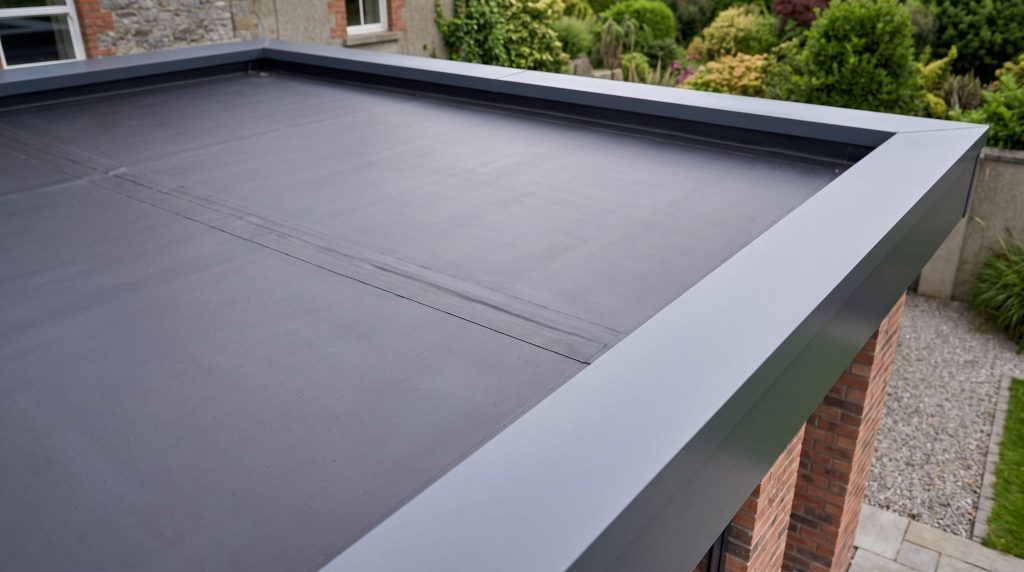
EPDM rubber roofing is a single-ply synthetic rubber membrane, made from ethylene propylene diene monomer. It is glued or mechanically fixed over a flat or low-pitched roof deck to form a watertight covering. It arrives in large sheets, so a small roof can often be covered with one piece and no joins at all.
The membrane sits on top of a solid deck, usually OSB or plywood, with a layer of adhesive holding it in place. Edges are finished with metal or PVC trims. Any pipes or upstands are sealed with flashing tape and preformed corners. Once cured, the result is a smooth rubber skin that flexes with the building instead of cracking.
How Much Does EPDM Roofing Cost in Ireland?
EPDM roofing in Ireland typically costs €90 to €140 per square metre supplied and fitted in 2026, with Dublin and other cities sitting at the upper end because labour is dearer there.
For a standard 20 square metre garage or extension roof, that works out at roughly €1,800 to €2,800 for a full new covering.
Here is how EPDM compares with the other common flat roof options on price and lifespan.
| Flat Roof Material | Typical 2026 Installed Cost | Common Lifespan |
| EPDM rubber | €90 to €140 per m² | 20 to 30 years |
| Fibreglass (GRP) | €70 to €130 per m² | 20 to 30 years |
| Torch-on felt | €50 to €90 per m² | 10 to 20 years |
Several things move the price up or down:
- Deck condition. Rotten or soft boards must be replaced before the membrane goes on, and this is often only confirmed once the old roof is stripped.
- Access. A roof you can reach from a ladder costs less than one that needs scaffolding.
- Detailing. Upstands, rooflights, outlets and box gutters all add labour.
- Insulation. Upgrading to a warm roof build-up adds material but improves comfort and energy use.
The final figure depends on your own roof, so it helps to estimate your project with a roof cost calculator before you ring around for written quotes.
How Long Does an EPDM Roof Last in Irish Weather?
A well-installed EPDM roof commonly lasts 20 to 30 years in the Irish climate, and many rubber membranes keep going beyond that with basic care.
Two things decide whether a rubber roof reaches its full lifespan:
1. The first is the deck and the fall. Water needs somewhere to run, so a roof laid with a proper slope will always outlast one laid dead flat.
2. The second is the number of joins. Because the membrane goes on in large sheets, there are far fewer seams than a felt roof, being one of the common causes of roof leaks on ageing flat roofs.
EPDM Rubber Roofing Kits vs Professional Installation

EPDM rubber roofing kits let a confident DIYer cover a small, simple roof such as a shed, porch or garden room, while a professional installation makes more sense on larger roofs, extensions and anything with several upstands or outlets.
Roofing Kit
A typical kit is sold by roof size and includes the rubber sheet cut to fit, contact adhesive, edge trims, flashing tape and a small tool pack. For a flat 3 by 3 metre shed roof with clean edges, a careful person can get a good result in a weekend.
Professional Installation
The trouble starts with detail. Corners, pipe penetrations, changes in level and tying into an existing tiled roof are where DIY jobs leak. A split membrane on a house extension is a far more expensive fix than the money saved.
A professional installer also fits a certified system, so it is worth asking whether the membrane holds product certification under Irish building rules before any work starts.
Pros and Cons of EPDM Roofing
EPDM roofing offers long life, low maintenance and strong value on flat roofs, but it is not perfect. It pays to weigh both sides before you commit. Most of the drawbacks are about looks and careful installation rather than performance.
What makes it a strong choice:
- Long lifespan of 20 to 30 years or more with minimal upkeep.
- Few joins, which cut the most common flat roof failure point.
- Flexibility that copes with temperature swings without cracking.
- Fast, cold installation with no torch or open flame on the roof.
Where it falls short:
- It usually comes in dark colours only, which can look flat on a prominent roof.
- It needs a clean, dry, solid deck, so a poor base undermines the whole job.
- It can be punctured by sharp impacts or heavy foot traffic if treated carelessly.
If you want a hard, smooth finish rather than a rubber one, fibreglass roofing is the usual alternative and offers a similar lifespan for a comparable price.
When EPDM Is the Right Choice for Your Flat Roof
EPDM is the right choice when you have a flat or gently sloping roof on an extension, garage, dormer or garden room and you want a long-lasting, good-value covering that copes with Irish weather.
Many rubber roofs go on rear extensions and garden rooms. Since 27 July 2026 you can extend a home by up to 45 square metres without planning permission under the updated rules for altering your home, subject to conditions. This makes flat-roofed extensions an easier project than they used to be.
If you are weighing it up for an extension, garage or garden room, arrange an on-site survey and a free fixed quote so you know the price before any work begins.