Skip to content

Metal roofing in Ireland usually costs between €80 and €350 or more per square metre installed, which puts a full metal roof on an average home somewhere around €11,000 to €25,000, with copper higher again. That gap is the whole story. “Metal roofing” is not a single product, and the metal roofing cost you get quoted depends almost entirely on which type you pick.
At the budget end sit profiled and tile-effect steel sheets. In the middle you have standing seam steel and aluminium. At the top are architectural zinc and copper, which is where the numbers climb fast. Get those three tiers straight and the pricing stops looking random.
This guide breaks down what each type costs per square metre, what pushes a quote up or down, and how metal stacks up against slate and tile, so you can budget with real figures before a single installer visits.
What Does Metal Roofing Cost in Ireland?
Metal roofing typically costs €80 to €130 per square metre for profiled and standing seam steel, rising to €130 and above for zinc, and higher again for copper. On an average semi-detached roof of 60 to 90 square metres, that works out at roughly €11,000 to €25,000 installed, depending on the metal and the detailing.
Those figures are for supply and fit. Scaffolding is often quoted as a separate line, and the exact total moves with your roof size, pitch, and county. Here is how the main options compare.
| Metal roof type | Typical installed cost per m2 | Lifespan |
| Tile-effect and profiled steel | €80 to €120 | 40 to 50 years |
| Standing seam steel and aluminium | €90 to €130 | 40 to 70 years |
| Zinc (standing seam) | €130 to €200+ | 60 to 80 years |
| Copper | €250 and up | 100+ years |
The safest way to sense-check a quote is to work in cost per square metre rather than the headline total, since it lets you compare like for like across installers. If you want a fast starting figure before you call anyone, you can estimate the cost for your own roof and then treat any quote that lands well outside that range with caution.
Why Metal Roof Prices Vary So Much
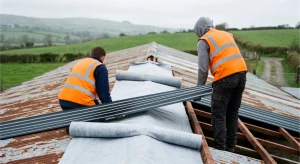
Metal roof prices vary because the term covers very different materials. Basic tile-effect steel is mass produced and quick to fit, while architectural zinc and copper are custom fabricated, formed on site, and need specialist labour. Material grade, detailing, and installer skill move the price far more than roof size on its own.
Tile-Effect and Profiled Steel
Tile-effect and stone-coated steel is the cheapest metal option, at roughly €80 to €120 per m² installed. The panels mimic slate or tile, weigh a fraction of the real thing, and go on fast, which makes them popular on extensions, garages, and budget
re-roofs. Raw corrugated and box-profile sheets are cheaper again at around €12 to €22 per m2 for material only, but that grade belongs on sheds and agricultural buildings, not a finished house roof.
Standing Seam Steel and Aluminium
Standing seam steel and aluminium runs €90 to €130 per m² installed, or about €11,000 to €20,000 on an average home. The raised vertical seams and hidden fixings give the clean, modern look you see on self-builds and contemporary houses, and the profile works on low pitches where tile struggles. Aluminium is light and highly corrosion resistant, which suits exposed coastal sites.
Zinc and Copper
Zinc and copper are the premium tier. Zinc standing seam starts around €130 per m2 for straightforward work and climbs past €200 for architectural detailing, while copper is the dearest of all, often €250 per m2 and up and priced per project. Both develop a natural patina, need almost no maintenance, and can last 60 to over 100 years. Slight surface waviness, known as oil canning, is a normal characteristic of these metals rather than a fault.
What Drives the Final Price
Beyond the metal itself, the final price is driven by roof size and pitch, design complexity, site access, the condition of the existing structure, your county, and VAT. Two homes on the same street can receive quotes thousands of euros apart for what looks like identical work.
- Roof size and shape. Everything is priced per square metre, and dormers, valleys, and hips add both labour and waste.
- Standing seam, zinc, and copper need bespoke flashings, folds, and soldered seams, so the more intricate the design, the higher the labour cost.
- Access and scaffolding. Scaffolding is usually a separate line, often around €1,000 to €3,500, and it is charged at the standard 23% VAT rate rather than the reduced construction rate.
- Existing roof condition. Rotten battens or failed decking found once the old roof comes off can add hundreds or thousands to the bill.
- Dublin and the commuter belt typically run 10 to 20% above rural rates.
Roofing that is supplied and fitted on an existing home qualifies for the reduced 13.5% VAT rate under Revenue’s guidance on construction services, while materials bought on their own are charged at 23%. Labour makes up roughly 50 to 65% of a metal roof quote, so who installs it matters as much as the metal you choose.

Metal Roofing vs Slate and Tile
Metal roofing costs more up front than concrete tile and sits close to or above natural slate per square metre, but it is lighter, quicker to install, and outlasts most tile. Slate still wins on heritage character and is often required in conservation areas or on protected structures, so the right choice depends as much on the house as the budget.
| Material | Cost per m2 | Lifespan | Best for |
| Concrete tile | €70 to €100 | 40 to 60 years | budget re-roofs |
| Natural slate | €110 to €160 | 75 to 100+ years | heritage and conservation |
| Standing seam steel | €90 to €130 | 40 to 70 years | modern homes, low pitch |
| Zinc | €130 to €200+ | 60 to 80 years | architectural self-builds |
The light weight of metal is a real advantage on complex shapes and extensions, where a heavy tile load would need extra structural support. It also pairs neatly with solar PV, because clamp-fixed panels can grip a standing seam without drilling holes through the roof covering.
Is a Metal Roof Worth It in Ireland?
For modern homes, extensions, and low-pitch roofs, a metal roof usually justifies its higher upfront cost. It stands up well to Irish wind and rain, lasts anywhere from 40 to over 100 years depending on the metal, needs little upkeep, and makes an ideal base for solar panels. On a straightforward traditional roof, though, concrete tile often gives better value.
The main trade-offs are the initial outlay and the need for a genuinely experienced installer, since poor detailing on metal shows up as leaks or movement problems later. Rain noise, a common worry, is largely solved by a proper insulated warm-roof build-up underneath. Spread the cost over the lifespan and the per-year figure often compares well with cheaper materials that need replacing sooner.
How to Budget and Get an Accurate Quote
To budget accurately, measure your roof area, decide which metal you want, then gather three itemised written quotes. Multiply your roof area in square metres by the per square metre rate for your chosen tier for a rough total, then confirm exactly what each quote covers before you compare them side by side.
- Estimate your roof area. Take the footprint (length times width) and multiply by about 1.4 for a standard pitch. A semi-detached roof is usually 60 to 90 m2.
- Pick your metal tier. Tile-effect steel for value, standing seam for a modern finish, zinc or copper for architectural projects.
- Get three itemised quotes. The spread on identical work is often €3,000 to €6,000, so comparison is the only way to know what fair looks like.
- Check what is included. Strip and disposal, membrane, battens, flashings, scaffolding, and VAT should all be spelt out.
- Ask about insulation grants. The roof covering itself carries no grant, but adding insulation at the same time can.
There is no direct grant for a re-roof, but if you add attic or rafter insulation during the works you can claim SEAI home energy grants for the insulation, currently up to €2,000 for attic insulation, and share a single scaffold hire across both jobs. A post-works BER assessment is required before the grant is paid.
A metal roof is one of the longest-lasting choices you can make for an Irish home, and getting the budget right comes down to matching the metal to your roof and pricing it properly rather than guessing. Once you have run rough numbers with the roof cost calculator, book a site survey to turn that estimate into a fixed price.