Skip to content

Roof trusses are the frame that holds your whole roof up, and their cost is one of the first numbers self-builders and homeowners ask about. For such a load-bearing part of the build, they tend to be cheaper than people expect.
In Ireland in 2026, a standard timber truss set for an average home costs roughly €2,000 to €4,500 to supply on its own, and closer to €6,500 to €12,000 once you factor in delivery, craning and fixing on site. Attic trusses that give you a room in the roof sit at the higher end, while one-off trusses for a garage or porch are a much smaller spend.
Below we break down what you’ll pay by truss type, what pushes the price up or down, and where the real savings are. If you want a quick figure for your own roof, you can run the numbers through HP Roofing’s roof cost calculator and we’ll come back with an estimate, but read on first so you know what those figures actually include.
How Much Do Roof Trusses Cost in Ireland?
There’s no single price tag, because a truss roof is priced by the metre and by design, not off a shelf. Still, here are the ballpark ranges we see across Dublin and Leinster in 2026.
- Supply only for a standard fink truss set runs around €2,000 to €4,500 for a typical three-bed semi delivered to site.
- Supply and fit for the same roof, with craning and fixing included, lands closer to €6,500 to €8,500.
- Larger detached homes with more complex rooflines push the fitted figure to €7,500 to €12,000 or more.
- Attic trusses cost more again, often adding €1,000 to €3,000 over standard trusses for the extra timber and strength.
- One-off trusses for a garage or porch are a small spend by comparison, which is why they’re sold individually.
For context, a full new roof in Ireland (structure, covering, labour and scaffolding) runs from about €9,000 to €24,000 in 2026, so the trusses are only one slice of the total. If you’re budgeting a replacement rather than a new build, our guide on how to work out the cost of a roof replacement sets the trusses against tiles, membrane and labour, which stops you comparing quotes that aren’t like for like.
What Affects the Price of Roof Trusses?
Two houses of the same size can get very different truss quotes. Design and engineering do most of the heavy lifting on price.
Truss Type and Roof Design
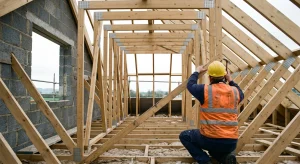
A fink truss, the common W-shaped design used on most Irish homes, is the cheapest option because it uses the least timber. Scissor trusses for vaulted ceilings cost more, and attic trusses cost more again. Hips, valleys and dormers all add trusses and cutting, so a plain gable roof will always come in lower than a cut-up roofline.
Span, Pitch and Timber Grade
The wider the span, the beefier the timber. Standard trusses reach about 11 metres in 35mm graded timber and up to 16 metres in 47mm timber, and the thicker sections cost more. A steeper pitch needs longer members too. Trusses are usually set at 600mm centres, but an engineer may call for 400mm centres under heavier loads like slate or solar, which means more trusses and a higher bill. Whatever the design, it has to meet Part A of the building regulations, and the state’s Technical Guidance Document A sets out the structural standard your truss maker designs to, so this isn’t a corner anyone should cut.
Standard Trusses Versus Attic Trusses
This is where a lot of self-builders spend real money, and it’s usually worth it. Attic trusses, also called room-in-the-roof trusses, are engineered so the space underneath stays open and usable.
That can add up to 40% more habitable floor area without changing the footprint of the house. They need two-ply timber and more of it, which is why they cost more than a plain fink set.
If you think you’ll ever convert the attic, paying for attic trusses now is far cheaper than retrofitting later, when you’d be stripping the roof or punching steel in to hold the load. It also changes how you insulate, because a room in the roof usually means a warm roof build-up, and our comparison of cold roofs and warm roofs explains why that matters for both comfort and condensation, which feeds straight back into your running costs.
Budget-wise, expect the attic upgrade to add somewhere in the €1,000 to €3,000 region on a standard house, more if you’re adding dormers or roof windows.

Supply Only or Supply and Fit?
This is the single biggest reason two quotes look miles apart. Supply only means the manufacturer designs, builds and delivers the trusses to your site, and you’re then responsible for craning them off the lorry and fixing them, which usually means your own carpenter and a crane for the day.
Supply and fit rolls all of that into one price. It costs more up front, but you’re not chasing separate trades or hiring plant yourself. For most homeowners who aren’t running the build themselves, supply and fit is the simpler route.
There’s one Irish quirk worth knowing about here, and that’s VAT. Supply and fit for a homeowner carries VAT at 13.5%, while trusses supplied on their own to a VAT-registered builder can be zero-rated under the reverse-charge rules. That gap is why trade prices and homeowner prices can look so different for what looks like the same set of trusses.

How to Keep Roof Truss Costs Down
You can’t cheat physics, but you can avoid paying over the odds.
- Keep the roofline simple where you can. Every hip, valley and dormer adds trusses and labour.
- Get the design finalised before you order. Changing a truss roof after it’s up is slow and dear because of the structural knock-on.
- Order attic trusses now if a conversion is even a maybe. Retrofitting later costs far more.
- Get three quotes and compare like for like on span, pitch and timber grade, not just the headline figure.
- Ask whether the price includes delivery and craning, because those extras can catch you out on a supply-only deal.
Insulation is the other place people underestimate. Once the trusses are up, the attic build-up and insulation spec drive both your comfort and your energy bills, and our breakdown of roof insulation costs in Ireland shows where that money goes so you can plan it into the same budget rather than as a surprise later.
Bottom Line on Roof Truss Costs
Roof trusses are one of the more affordable parts of any Irish build, cheaper and faster than a cut roof and used on nearly every new home for good reason. Get the design right, decide early on attic space, and the trusses rarely become the part of the project that blows your budget.
Building or re-roofing in Dublin or Leinster? Talk to HP Roofing on 01 453 3366 for a truss design and a straight quote.