Skip to content

Skylight installation cost in Ireland typically runs between €1,000 and €2,000 per window, supplied and fitted, on a standard pitched roof. That covers the window itself, the flashing kit, labour, and making good around the opening. Replacing an existing skylight in the same opening involves less work, while flat roof skylights and electric models push the total higher.
The wide range catches people out. The same window can cost €1,200 on one house and over €2,000 on the next, and the difference is rarely the glass. It comes down to the roof covering, the access, and the finishing work needed inside the room.
This guide breaks down where the money actually goes, why quotes vary so much between houses, and how to tell a solid fixed quote from a guess.
How Much Does Skylight Installation Cost?
Most standard skylight installations on Irish pitched roofs land between €1,000 and €2,000 per window for supply and fit. Labour is usually the biggest single line, not the window. Fitting a second or third window on the same visit brings the per-window price down, because the access and setup costs are shared.
Here is how a typical supply and fit price breaks down:
| Cost item | Typical range |
| Skylight window (standard, manual) | €500 to €1,200 |
| Flashing kit | €100 to €250 |
| Labour per window | €600 to €1,200 |
| Scaffolding or access equipment | €200 to €500 |
A few things move you within that range. Larger glazing sizes and triple-glazed units cost more to buy. Electric and solar-powered opening models sit at the top end of the window pricing. In practice, a compact manual centre-pivot roof window on an accessible tiled roof is the cheapest realistic job, and a large electric unit on a high slate roof is the dearest.
If you want a rough figure for your own roof before ringing anyone, the roof cost calculator gives you a starting estimate you can sanity-check quotes against.
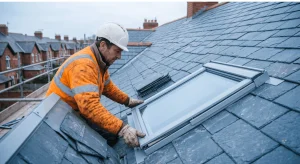
Why Do Skylight Quotes Vary So Much?
Two identical windows can carry very different installed prices because the roof around them does most of the work. The covering, the height and access, and the finishing needed inside the room move a quote far more than the brand on the glass does. Check these three factors before comparing prices between installers.
Roof Covering and Pitch
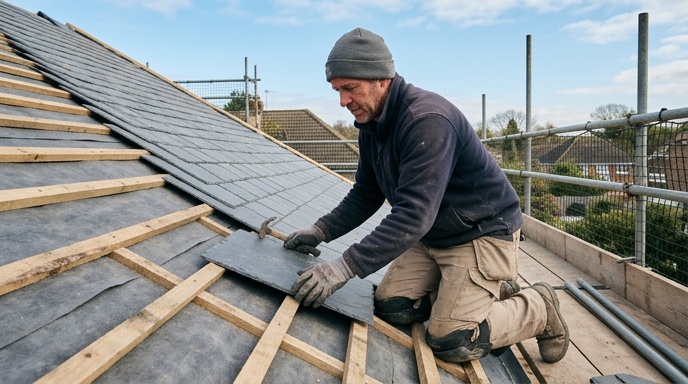
Cutting into a concrete tiled roof is straightforward work for an experienced crew. Natural slate takes longer, because slates crack easily, each one around the opening needs careful dressing, and the flashing detail has to be tighter. Steeper pitches slow everything down again. On older Dublin slate roofs, expect the labour portion to sit at the higher end.
Access and Scaffolding
A single-storey extension reachable from a ladder is the cheap version of this job. A two-storey terraced house with no side access usually needs scaffolding, which adds €200 to €500 before a single tile is lifted. Some installers bury this in the total, so ask for it as a separate line.
Finishing the Light Shaft Inside
From outside, the window sits in the roof. From inside, it sits at the top of a plastered shaft that has to be built, insulated, boarded, and skimmed. A room with the ceiling directly under the roof needs minimal making good. A deep shaft through an attic space is carpentry, insulation, and plastering on top of the roofing work, and it shows in the price.
New Opening or Replacing an Existing Skylight?
Cutting a brand new opening is the expensive version of this job. A like-for-like replacement into an existing opening skips the structural work entirely, and most swaps are completed from inside the house in a matter of hours. You still pay full price for the new window, so the saving comes from labour and finishing rather than materials.
Velux runs its own replacement supply and fit service in Ireland and quotes an average of €1,400 to €1,800 for the supply and installation of one replacement roof window, which gives a useful benchmark to hold independent quotes against. A roofer pricing a straight swap should be competitive with that, particularly if flashing or surrounding slates need attention on the same visit.
If your existing unit is fogged, leaking, or stiff to open, weigh up repair against replacement first. A failed hinge or perished seal is often fixable, and our guide to common skylight faults and repairs covers when a repair makes sense and when the money is better put towards a new unit.
Which Type of Skylight Should You Budget For?
Fixed skylights are the cheapest to buy and fit, manual opening models sit in the middle, and electric or solar-powered units cost the most. On flat roofs, a kerb-mounted flat roof skylight involves membrane and upstand work, so it usually costs more than a pitched roof window of the same glazing size.
- Fixed skylights suit hallways, stairwells, and rooms with ventilation elsewhere. Lowest unit cost, simplest fit.
- Manual opening roof windows are the standard choice for bedrooms and attic conversions. Centre-pivot is the most economical opening style.
- Electric and solar-powered models add remote opening and rain sensors, and add several hundred euro to the window price.
- Flat roof skylights need a builder’s kerb and proper integration with the membrane, so the labour is closer to flat roofing work than window fitting.
Whichever type you choose, the flashing kit matched to your exact roof covering is not optional. Most leaking skylights we’re called to were fitted with the wrong flashing, or with none, and the fix costs more than the kit ever would have.

Do You Need Planning Permission for a Skylight?
Most rear-facing skylights in Ireland go in without planning permission, but the rules are less clear-cut than people assume. Irish planning regulations contain no specific exemption class for roof lights, so councils interpret them case by case. Rear installations are routinely treated as exempt, while front-facing windows are handled differently from one local authority to the next.
Protected structures and homes in architectural conservation areas are the firm exception, and permission or consent is normally needed there regardless of which slope the window sits on. If you’re unsure, you can apply to your council for a Section 5 Declaration, a formal written ruling on whether your job is exempt, and the official guidance on planning permission for home alterations explains how that process works.
We’ve covered the feasibility side in more depth, including structural checks and which roofs suit a roof window, in our guide on whether you can put a Velux window in your roof, which is worth reading before you commit to a position on the roof.
How to Get an Accurate Skylight Quote
An accurate skylight quote is itemised, fixed in writing, and based on someone actually looking at your roof. Pitch, covering condition, and the internal shaft are hard to price from a phone call, and vague verbal figures are where budget overruns start.
Before you accept any price, check that it covers:
- The exact window model and size, not just “a Velux”
- The correct flashing kit for your roof covering
- Labour, access, and scaffolding as visible lines
- Insulation collar and internal making good
- Waste removal and a workmanship guarantee in writing
Fitting a skylight means deliberately breaking a weatherproof barrier and rebuilding it around glass, so the fitter matters more than the window brand. Our crews have been cutting roof windows into Dublin slate and tile since 1969, we carry full insurance, and every job gets a written fixed quote before a ladder goes up. If you’re ready for real numbers on your own roof, book a survey through our skylight installation service and we’ll price it properly.